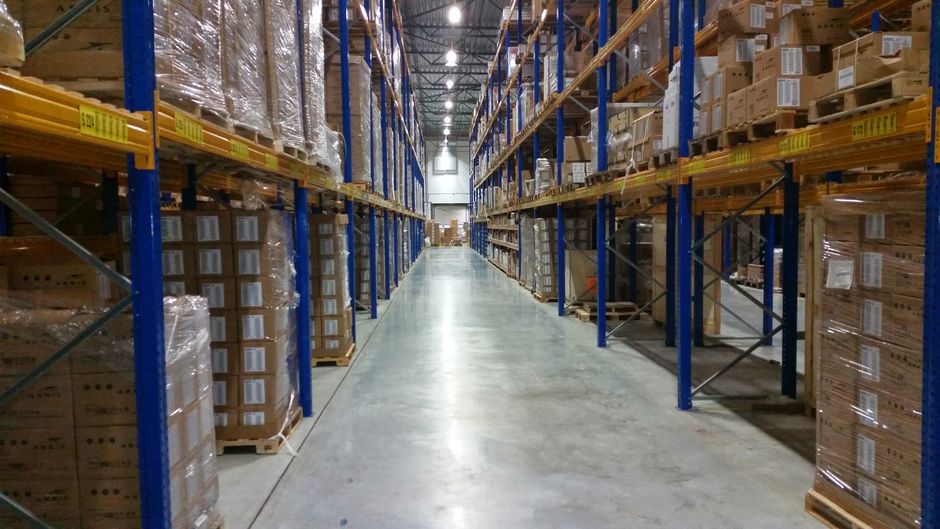
The wholesale double squeeze: paying for stock before retailers pay you
Wholesale distribution runs on a cash-flow trap that few other sectors face in the same form. Your company pays for stock upfront, sometimes months upfront when goods are imported, then sells that stock to retailers on 30 to 60-day credit terms. Cash goes out at the start of the cycle and comes back at the end, and the gap in the middle is where wholesalers get squeezed.
It is a double squeeze, not a single one. On one side, working capital is tied up in the goods sitting in your warehouse, bought and paid for but not yet sold. On the other, it is tied up in the sales ledger, invoiced and delivered but not yet paid. A wholesaler can be profitable on paper and still run out of cash, because both ends of the trade cycle demand funding at once. Add a seasonal build, where you buy heavily for a Q4 or back-to-school peak before a single retailer has ordered, and the squeeze becomes acute.
Invoice finance was built for the second half of that problem: turning your unpaid retailer invoices into cash the moment you raise them, instead of waiting 45 days for the money to arrive. For most wholesalers it is the single most effective way to unlock the cash trapped in the debtor book. This guide explains how it fits a wholesale business, how it stacks with stock and trade finance to cover the first half of the squeeze too, and how much your limited company could realistically release.
Company borrowers only: who this page is for
The finance introductions on this page are for UK limited companies and limited liability partnerships borrowing for business purposes. We introduce your company to a panel of commercial-finance brokers. We are not a lender and do not give regulated credit advice. If you are a sole trader, an individual, or borrowing for personal or household purposes, this service is not for you, and you should speak to an FCA-authorised consumer-credit firm.
The reason for that fence is regulatory, not arbitrary. Introducing a body corporate (a limited company) to a lender or broker is not a regulated activity under Article 36A of the Financial Services and Markets Act 2000 (Regulated Activities) Order 2001. Borrowing by a sole trader or individual below the relevant thresholds is consumer credit and needs FCA authorisation. So everything below assumes your wholesale business trades as an incorporated company. Facilities are typically arranged from £25,000 upward.
Why invoice finance fits wholesale companies well
Wholesale is one of the strongest natural fits for invoice finance, for three reasons rooted in how the sector actually trades.
You raise real B2B invoices on credit terms. Unlike a card-led retailer or a hospitality venue, a wholesaler sells to trade customers who pay on account. Every delivery generates an invoice with a due date, and that invoice is the asset the facility advances against. No invoice, no funding; wholesale generates them by the hundred. Invoice finance is one of the most widely used working-capital tools in UK business, with billions advanced against B2B ledgers each year, as UK Finance reports for the invoice finance and asset-based lending market.
Your debtor book is spread across many small retailers. A distributor selling to 100 or more independent shops has a well-diversified ledger. Lenders like this, because no single customer failing to pay threatens the whole book. Debtor concentration is one of the first things a funder assesses, and a broad wholesale ledger usually supports a higher advance rate than a business leaning on two or three large accounts.
The many-accounts problem is a credit-control problem. Chasing payment from dozens of small retailers is time-consuming, and it is precisely the job a factoring facility takes off your desk. The lender runs the sales ledger and collections, so your team stops chasing and starts selling. For a lean wholesale operation, outsourced credit control is often as valuable as the cash itself.
Factoring or invoice discounting for a distributor?
Invoice finance comes in two main forms, and the choice matters more for wholesalers than for most sectors because of that many-small-accounts profile.
Factoring is disclosed and includes credit control. The lender manages your sales ledger, chases the retailers, and collects payment into a facility account, so your customers know a finance provider is involved. For a wholesaler drowning in small-account admin, this is usually the right answer: you release cash and hand off the collections work in one facility.
Invoice discounting is confidential and you keep collections in-house. Your retailers pay you as normal and are unaware of the facility. It suits larger, well-resourced wholesalers with a capable finance team, a strong balance sheet, and the turnover and systems that discounting lenders require. It can be cheaper than factoring because you do the collections work yourself.
The honest rule of thumb: if your pain is administrative (too many retailers to chase), choose factoring. If your pain is purely cash and you can manage the ledger yourself, discounting is often the lower-cost route. Our two deeper guides, on invoice factoring and invoice discounting, cover the mechanics, the recourse question, and the exit traps in full.
Stacking invoice finance with stock and trade finance
Invoice finance solves the back half of the wholesale squeeze, the sales ledger. It does nothing, on its own, for the front half, the stock you have to buy before you can sell it. During a seasonal build there are no invoices yet to finance, so a standalone invoice facility leaves the hardest part of the cycle uncovered.
This is why serious wholesale funding almost always stacks two products. Stock finance (or inventory finance) advances cash against goods held in your warehouse. Trade or import finance pays your supplier, often overseas, and gives you a window to land, sell, and invoice the goods before the facility is repaid. Layer invoice finance on top and the full trade cycle is funded end to end: the trade line buys the stock, the stock sits funded in the warehouse, and the invoice facility releases cash the moment you sell and bill a retailer, repaying the earlier draw.
Lenders that offer all three under a single asset-based lending (ABL) arrangement can fund a wholesaler from purchase order to paid invoice. That is the structure to ask for if import lead times and seasonal builds are your real problem, not just slow-paying retailers. The British Business Bank guidance on business finance options is a useful neutral overview of how these products differ. The working capital finance guide maps how these products fit together across a full trading cycle.
How much a wholesaler could release: a worked example
Consider a limited company distributing giftware and homeware. It holds around £400,000 of stock at any time, sells to 120 independent retailers on 45-day terms, and carries a sales ledger of roughly £300,000. Every autumn it builds stock for the Christmas peak, buying heavily in September for sales that will not be invoiced until October and November and not paid until December and January.
Here is how a stacked facility changes the cash position through the peak.
| Stage of the cycle | Without finance | With stacked facility |
|---|---|---|
| September stock build (£400k) | Cash paid out upfront, reserves drained before a single sale | Stock finance funds the purchase; company cash preserved |
| October to November sales (£300k ledger) | Invoiced, delivered, but £300k locked up for 45 days | 85% advance releases ~£255k within 24-48 hours of invoicing |
| Credit control on 120 accounts | Internal team chases every small retailer | Factoring lender runs the ledger and collections |
| December to January collection | Cash finally arrives, weeks after the peak | Balance (less fees) paid over as retailers settle; advance repaid |
On the £300,000 ledger, an 85% advance releases roughly £255,000 almost immediately, instead of waiting 45 days for it. The service fee (a percentage of turnover, covering credit control and administration) and the discount margin (a rate over base, covering the cost of the cash advanced) are the price of that. For a wholesaler, the cost is usually far cheaper than the alternative: turning away peak orders because the cash to buy stock is not there, or paying suppliers late and losing early-settlement discounts. Advance rates on a well-spread wholesale book typically run 80% to 90%.
Want this checked against your specific situation?
Leave your details and a one-line summary. A specialist will reply within 24 hours, with no obligation.
Eligibility: what lenders assess in a wholesale application
Because invoice finance is secured against your invoices rather than your trading history, the lender's focus is the quality of the ledger, not just the age of the company. For a wholesaler, expect them to look at:
- Company status. A UK limited company or LLP selling on credit terms. Sole-trader wholesale operations fall outside this service (see the fence above) and should approach an FCA-authorised firm.
- Your debtor book. The spread of retailers, their creditworthiness, average payment days, and how many invoices are overdue. A broad book of solvent retailers on standard terms is the ideal.
- Debtor concentration. Whether one large retail chain dominates the ledger. Concentration caps how much of that single debtor the lender will fund.
- Invoicing and delivery process. Clean proof of delivery and undisputed invoices. Lenders exclude disputed, intercompany, or very overdue debts from the funded pool.
- Any B2C slice. Direct-to-consumer or trade-counter cash sales are not invoices and cannot be factored; only the trade-credit portion of turnover qualifies.
Turnover matters too, mostly in determining whether factoring or confidential discounting is on the table. Most wholesalers trading at these levels are already above the £90,000 VAT registration threshold; invoice finance advances the gross, VAT-inclusive invoice value, so you receive cash against the full amount billed while accounting for the VAT to HMRC as normal.
What to watch: seasonality, imports, and retailer failure
A few wholesale-specific points repay attention before you sign.
Match the facility to your seasonality. A whole-turnover facility that flexes upward through your peak absorbs a seasonal build far better than a fixed loan sized to your quiet months. Ask how the funding line behaves when your ledger doubles in Q4.
Cover the import gap separately. Invoice finance cannot fund goods in transit, because there is no invoice yet. If long lead times from overseas suppliers are your real squeeze, insist on a trade or import finance line alongside the invoice facility, ideally from a lender that offers both.
Consider bad-debt protection. Independent retailers do fail. Under a recourse facility, an unpaid invoice is charged back to your company; under non-recourse, the lender carries the risk on approved customers for a higher fee. For a book of many small retailers, a bad-debt protection add-on can be worth the cost.
Read the termination terms. Factoring agreements can carry notice periods and trailing commission on exit. Know the cost of leaving before you commit, as covered in the factoring guide linked above.
The tax angle, in one hop
The finance side is the focus of this page, but two tax points are worth flagging. Service fees and discount margins on a business invoice finance facility are normally allowable revenue expenses for corporation tax, deductible because they are incurred wholly and exclusively for the trade, which reduces your taxable profit. And if part of your working-capital plan involves buying warehouse racking, handling equipment, or vehicles, capital allowances (the Annual Investment Allowance and full expensing) can shelter that spend against tax. We do not re-explain the tax mechanics here; see the Annual Investment Allowance guide and speak to an accountant for how the costs interact with your corporation tax and VAT position. Our secondary lead route below connects you to Holloway Davies for exactly that structuring conversation.
How to apply
Applying is straightforward once you have your numbers to hand. You will want your latest sales ledger or aged debtor report, recent management accounts, details of your main retail customers, and, if you import, an idea of your supplier terms and stock holding. The government's business finance and support pages are a good starting point for understanding the funding landscape before you approach the panel. From there:
- Confirm your company is a UK limited company or LLP (the company-gate on the form below).
- Share your turnover, debtor book value, and whether you also need stock or import finance.
- Be introduced to our panel of commercial-finance brokers, who compare factoring, discounting, and stacked ABL options across multiple lenders.
- Review the advance rate, service fee, and margin offered, and choose the facility that matches your seasonality.
For the wider picture of how invoice finance sits alongside other funding, start with the invoice finance guide, our pillar page for the whole cluster, or the business loans guide if a term facility might suit part of the need. When you are ready, complete the form below to get started.