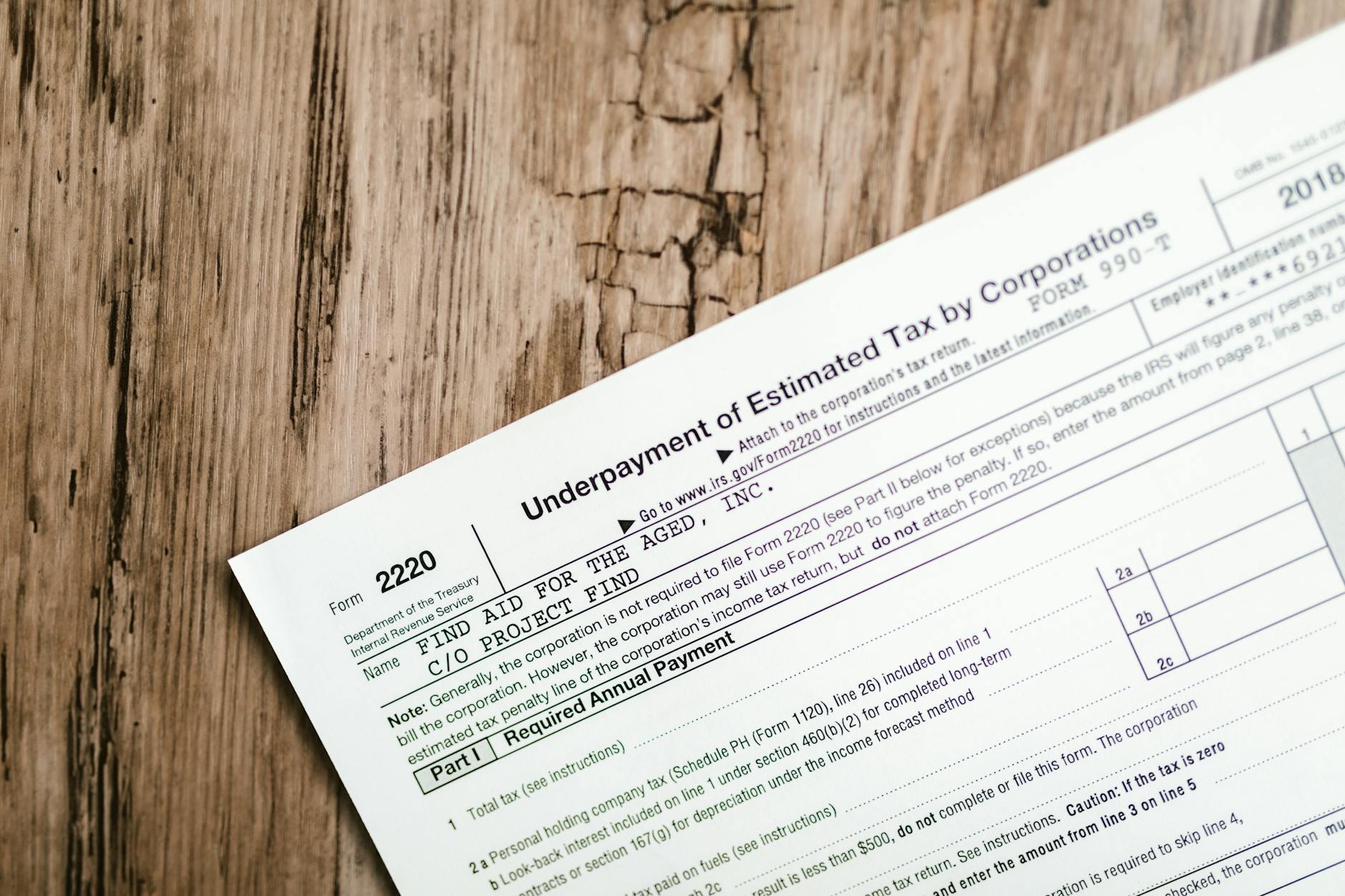
If you run a limited company in the UK, corporation tax is your single biggest direct tax cost after salaries. Getting it wrong means either paying too much or facing penalties from HMRC. A corporation tax accountant is the professional who makes sure you land on the right number and keep more of your profit.
But what exactly do they do for the fees they charge? The answer varies depending on your company's size, complexity, and whether you have straightforward trading profits or more complicated affairs like R&D, capital disposals, or overseas income.
Here is a practical breakdown of what a corporation tax accountant actually handles for a typical UK limited company director.
Preparing and Filing the CT600 Corporation Tax Return
The core job is preparing the CT600. This is HMRC's form for reporting your company's taxable profits and calculating the tax due. It is not a simple one-page form. The CT600 has multiple supplementary pages depending on what your company does: loans to participators, group relief, R&D claims, creative industry reliefs, and more.
Your accountant will take your annual accounts (which they may also prepare) and convert them into the tax-adjusted profit figure. This is rarely the same as the profit shown in your management accounts or even your statutory accounts. There are disallowable expenses like client entertainment, depreciation adjustments, and capital allowance claims that shift the number.
For a straightforward trading company turning over £150,000 with £45,000 profit, the CT600 might take an experienced accountant an hour or two. For a company with multiple associated companies, group structures, or R&D claims, it can take significantly longer.
The filing deadline is 12 months after your accounting period end. But the payment deadline is much earlier: 9 months and 1 day after year-end. Your accountant should make sure you know both dates and file well before the filing deadline to avoid late filing penalties.
Calculating the Correct Tax Rate and Marginal Relief
Since April 2023, corporation tax is not a flat rate for all companies. The small profits rate is 19% on profits up to £50,000. The main rate is 25% on profits above £250,000. Between £50,000 and £250,000, marginal relief applies. This means your effective tax rate gradually increases from 19% to 25% as your profits rise.
Here is where a corporation tax accountant earns their fee. Marginal relief is calculated using a specific formula that HMRC publishes. The fraction changes each year. For the 2025/26 tax year, the marginal relief fraction is 3/200 (for non-ring fence profits). Your accountant applies this to your profits and works out the exact amount of relief due.
Take a company with £120,000 of taxable profits. The tax calculation is not simply 25% of £120,000. The first £50,000 is taxed at 19%, the remaining £70,000 is taxed at 25% minus marginal relief. The relief tapers the effective rate. An accountant who knows the marginal relief mechanics will calculate this precisely. A director doing it themselves might overpay by thousands.
Marginal relief also interacts with associated companies. If your company has one other associated company (a common situation for director-owned groups), the profit thresholds are divided by the number of associated companies. So the 19% band drops to £25,000 and the 25% band starts at £125,000. Missing this is a common error.
Identifying Capital Allowances and Reliefs
Most directors know they can claim capital allowances on plant and machinery. But the specifics matter. The Annual Investment Allowance (AIA) gives 100% relief on the first £1,000,000 of qualifying expenditure for most assets. Full Expensing gives a similar result for limited companies on main-rate assets. But not everything qualifies.
A corporation tax accountant will review your asset purchases and classify them correctly. Cars have their own rules. Zero-emission cars (0g/km CO2) qualify for the 100% first year allowance. Cars emitting 1-50g/km enter the main rate pool and attract the standard writing-down allowance; cars above 50g/km go into the special rate pool at the lower rate. Structures and buildings qualify for 3% straight line relief under the Structures and Buildings Allowance (SBA).
They will also spot reliefs you might not know about. If you spent money on patent rights, know-how, or certain types of software, there may be additional allowances. If you refurbished a commercial property, parts of the spend may qualify as plant and machinery rather than just building works. This distinction can be worth tens of thousands of pounds in tax saved.
Managing the Director's Loan Account
The director's loan account (DLA) is a frequent source of corporation tax issues. If you take more money from the company than you have put in or earned through salary and dividends, the DLA goes overdrawn. HMRC treats this as a loan to a participator.
The company must pay S455 tax at 33.75% (for loans made in 2025/26) or 35.75% (for loans made on or after 6 April 2026) on the outstanding loan amount if it is not repaid within 9 months and 1 day of the year-end. This tax is repayable when the loan is eventually repaid or written off, but it ties up cash in the meantime.
Your corporation tax accountant will flag this situation well before the year-end if they are on top of your bookkeeping. They can advise on whether to declare a dividend to clear the overdrawn balance, or restructure the repayment timeline. They will also include the correct supplementary pages on the CT600 if a loan is outstanding.
If you have a loan of £20,000 made in 2026/27 that was overdrawn at year-end and not repaid within 9 months, the S455 tax charge is £7,150 (£20,000 at 35.75%). A loan taken in 2025/26 would carry a charge of £6,750 (33.75%). That is cash the company could have kept if the situation had been managed differently. A good accountant prevents this.
Handling R&D Tax Credits
If your company does any technical work to resolve uncertainty in science or technology, you may qualify for R&D tax credits. This is not just for labs and pharmaceutical companies. Software developers, engineers, manufacturers, and even some service companies can qualify if they are pushing beyond existing knowledge.
From April 2024, the merged R&D scheme applies to all companies. Under the merged scheme, all companies can claim a 20% expenditure credit (RDEC). For loss-making SMEs where R&D spend exceeds 30% of total costs, the Enhanced R&D Intensive Scheme (ERIS) offers a more generous alternative (86% additional deduction or a 14.5% payable credit).
A corporation tax accountant who specialises in R&D claims will review your project descriptions, identify qualifying costs (staff, subcontractors, consumables, software licences), and prepare the Additional Information Form (AIF) that must now accompany every claim. They will also advise on whether to use the merged scheme or ERIS depending on your company's profitability.
For a software consultancy in Manchester with £80,000 of qualifying R&D spend, the RDEC claim could be worth £16,000 in tax reduction or payable credit. But only if the claim is prepared correctly. HMRC has been challenging R&D claims aggressively since 2023, and poorly prepared claims can trigger full reviews of your entire corporation tax history.
Check if and when MTD applies to you
Skip the spreadsheet. Tell us about your situation and a specialist will review your position and the next sensible step, with no obligation.
Advising on Payment Timing and Quarterly Instalments
Most small companies pay corporation tax 9 months and 1 day after year-end. But if your taxable profits exceed £1.5 million, you must pay by quarterly instalments. The threshold is reduced if you have associated companies.
Your accountant will calculate whether you are in the instalment regime and set up the correct payment schedule with HMRC. Missing an instalment deadline triggers interest charges from HMRC at the late payment rate, which is typically 2.5% to 4% above Bank of England base rate.
Even for companies below the instalment threshold, your accountant can advise on whether to make a payment on account or wait until the deadline. If you have a large tax bill, paying early reduces interest but ties up cash. Paying at the deadline keeps cash in the business longer but risks missing the date. Your accountant will run the numbers both ways.
Dealing with HMRC Enquiries and Compliance Checks
HMRC opens compliance checks on corporation tax returns more often than many directors realise. They target specific risk areas: high director's loan accounts, R&D claims, property development companies, and companies with consistently low profits relative to turnover.
If HMRC opens a check, your corporation tax accountant will handle the correspondence. They will review what triggered the check, prepare the supporting evidence, and respond to HMRC's information requests. They will also advise on whether to agree to HMRC's proposed adjustments or appeal them through the tribunal system.
The cost of an HMRC enquiry can be significant if you handle it badly. Penalties for careless inaccuracies can reach 30% of the additional tax due. Deliberate inaccuracies carry penalties up to 100%. Having an accountant who knows the enquiry process and can demonstrate reasonable care in the original return preparation is the best defence.
What a Corporation Tax Accountant Does Not Do
It is worth being clear about the boundaries. A corporation tax accountant prepares the corporation tax return and advises on the tax position. They do not typically prepare your management accounts, process your payroll, or handle your VAT returns unless you engage them for those services separately.
Many accountants offer a combined service that includes bookkeeping, VAT, payroll, and corporation tax. But if you only need the corporation tax return prepared, make sure the scope of work is clear from the start. Some accountants will prepare the CT600 from your statutory accounts. Others expect to prepare the accounts themselves as a prerequisite.
If you use a cloud bookkeeping platform like Xero or FreeAgent, your accountant can access the data directly and prepare the corporation tax return without you sending them spreadsheets. This is the most efficient arrangement for most small companies.
How to Choose a Corporation Tax Accountant
Not all accountants are equally skilled at corporation tax. Some focus on sole traders and personal tax. Others specialise in limited company work. You want someone who deals with CT600s regularly and understands the specific rules for your sector.
Ask them how many corporation tax returns they file each year. Ask if they have experience with your industry. If you are a contractor working through your own limited company, find an accountant who understands IR35 and the specific tax planning that applies to personal service companies. If you are a property developer, find someone who knows the trading vs investment distinction and the CGT implications of disposals.
At Holloway Davies, our specialist team prepares corporation tax returns for limited companies across every sector. We handle the CT600, marginal relief calculations, capital allowance claims, and R&D credits as part of a comprehensive corporation tax service. We also advise on director's loan accounts, associated company rules, and payment timing.
If your company has a year-end approaching or you want a second opinion on your current corporation tax position, get in touch. We will review your situation and tell you exactly what we can do to reduce your tax bill and keep you compliant.