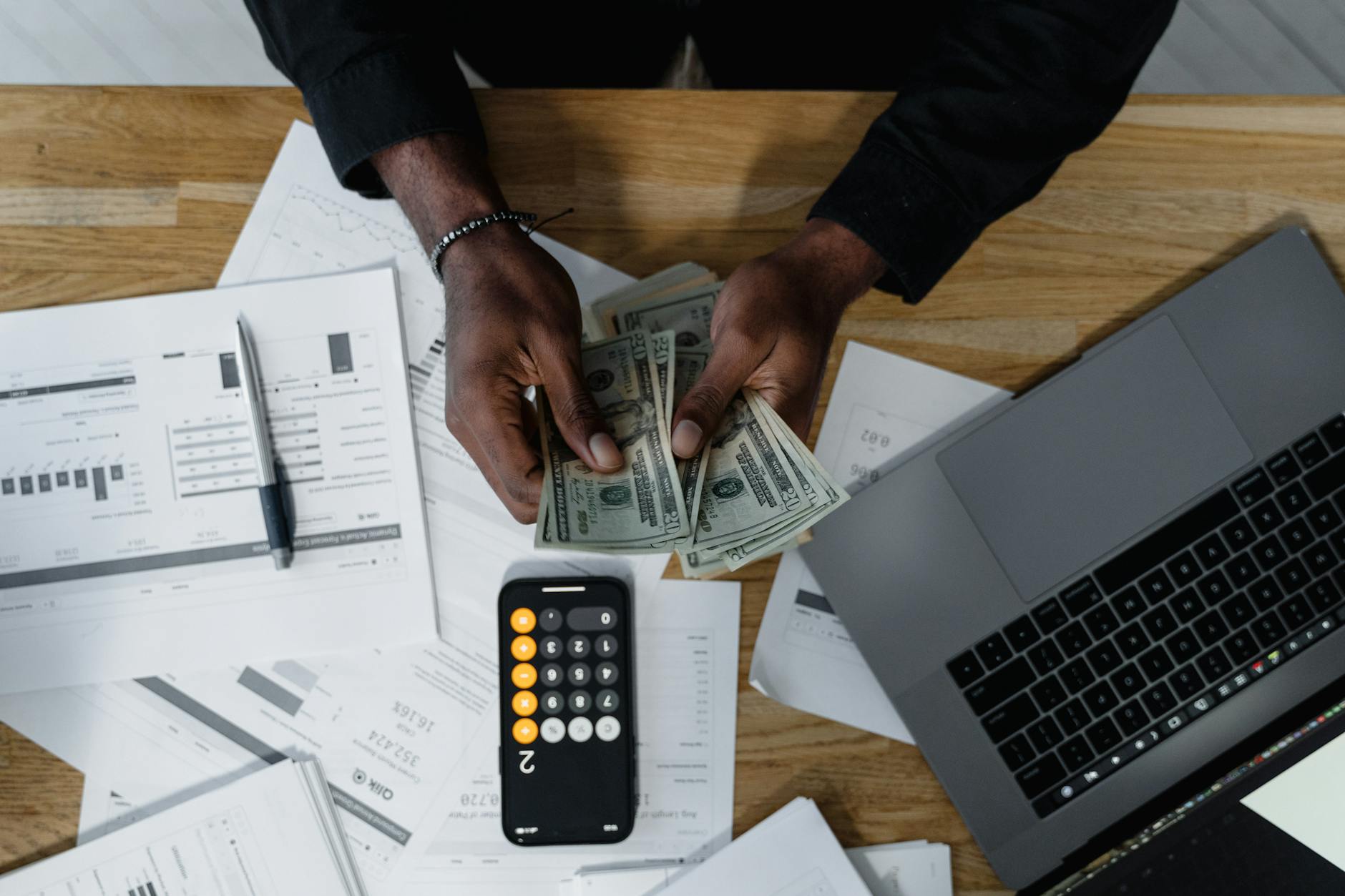
If you are a sole trader using cash accounting, most standard accounting advice you find online is written for the wrong system. It assumes accruals: that you record income when you invoice and expenses when you receive the bill. Cash accounting works differently. You record income when the money lands in your bank account and expenses when the money leaves it. That changes how you file your tax return, how you manage your bookkeeping, and how you plan your tax bill.
A sole trader accountant who understands cash accounting does not force accrual logic onto your records. They work with the actual timing of your cash flows. That is a different skill set. And if your accountant does not recognise the difference, you can end up paying more tax than you need to, or missing reliefs you are entitled to.
This post explains exactly what changes when you use cash accounting, what your accountant should be doing differently, and how to check you are getting the right support.
What Is Cash Accounting for Sole Traders?
Cash accounting is the default basis for sole traders in the UK. From 6 April 2024, under the Finance (No. 2) Act 2023, HMRC made cash basis the default method for all sole traders and partnerships regardless of turnover. There is no turnover ceiling. If you prefer accruals, you must positively elect for it on your Self Assessment return.
Under the cash basis:
- You record income when you receive payment, not when you issue the invoice.
- You record expenses when you pay them, not when you receive the bill.
- You do not adjust for debtors or creditors. There is no prepayments or accruals adjustment.
- You can use simplified expenses for vehicle costs, working from home, and private use of business premises.
This is simpler than accruals accounting. It matches your tax position to your actual bank balance. But it creates specific challenges that a standard accountant trained on accruals may not handle well.
How a Sole Trader Accountant Should Handle Cash Basis Bookkeeping
The biggest difference is in how your books are structured. Under accruals, your accountant wants to see invoices raised and bills received, matched to the period they relate to. Under cash accounting, your accountant wants to see bank statements and payment dates.
Your sole trader accountant should be organising your records around your bank feed, not your sales ledger. That means:
- Reconciling every transaction against your bank statement, not against invoice dates.
- Treating a payment received in April for a March invoice as April income, not March income.
- Treating a bill paid in May for an April expense as May expense, not April expense.
If you use accounting software like Xero, QuickBooks, or FreeAgent, your accountant should set the tax basis to cash. Most of these platforms default to accruals. If your accountant does not change that setting, your profit and loss report will show the wrong figures for your tax return.
At Holloway Davies, we routinely set up cash basis accounting for sole traders. It is not a niche adjustment. It is the default for most of our sole trader clients. But it must be done deliberately.
Simplified Expenses and What They Mean for Your Tax Return
Cash accounting lets you use simplified expenses for certain categories. These flat-rate deductions replace the need to calculate actual costs. Your accountant should know exactly when to use them and when actual costs are better.
Vehicle Costs
Simplified vehicle expenses use a flat rate per business mile. For 2026/27, the rates are 55p per mile for the first 10,000 miles and 25p per mile thereafter for cars and vans. Motorcycles are 24p per mile.
Your accountant should compare this against your actual vehicle costs (fuel, insurance, servicing, depreciation) and tell you which gives the bigger deduction. For a sole trader driving 12,000 business miles a year in a low-cost car, simplified expenses often win. For someone driving 5,000 miles in a new electric car with low running costs, actual costs may be better.
Working from Home
HMRC simplified expenses for sole traders working from home use monthly flat rates based on hours of business use per month: £10 per month for 25 to 50 hours, £18 per month for 51 to 100 hours, and £26 per month for 101 hours or more. The minimum is 25 hours of business use per month (not per week). No receipts are needed. Note that the £6 per week figure applies to employees and their employers, not to sole traders using simplified expenses. Your accountant should check whether the applicable flat rate is better than claiming a proportion of actual household costs like rent, mortgage interest, council tax, and utilities.
For a sole trader with a dedicated home office in a London flat, actual costs will often beat even the top band of £26 per month. For someone using a corner of the dining table a few days a week, the flat rate is simpler and adequate.
Private Use of Business Premises
If you run a business from premises you also live in (a shop with a flat above, for example), simplified expenses let you claim £350 per month for one person, £500 per month for two. Your accountant should model both the simplified and actual cost methods.
These decisions are where a specialist sole trader accountant adds real value. A generalist may default to simplified expenses because they are easier. A good accountant runs the numbers both ways.
What Changes on Your Self Assessment Tax Return
Your SA103 (self employment pages) asks you to confirm whether you are using the cash basis. Your accountant must tick the right box. If they tick accruals but prepare your figures on cash basis, HMRC may query the return.
The cash basis affects three key areas on your return:
- Turnover. You report income received, not invoiced. If you have outstanding invoices at year end, they are not included.
- Expenses. You report costs paid, not incurred. Unpaid bills at year end are not deducted.
- Capital allowances. Under cash accounting, you cannot claim capital allowances on most assets. Instead, you deduct the full cost of plant and machinery (up to certain limits) as an expense when you pay for it. Your accountant must know this rule. Claiming capital allowances on a cash basis return is a common error.
You can choose to use accruals by electing out of cash basis on your return. But once you opt out of cash basis, you cannot switch back for 12 months. Your accountant should advise you on which basis gives the lower tax bill, not just default to one.
Free Sole trader and self-employment tool
Calculate your take-home pay as a sole trader
Our interactive tool is designed for a larger screen. Leave your details and a specialist will send your figure and the next sensible step, with no obligation.
Calculate your take-home pay as a sole trader
Skip the spreadsheet. Tell us about your situation and a specialist will review your position and the next sensible step, with no obligation.
Making Tax Digital for Income Tax and Cash Accounting
MTD for ITSA (Making Tax Digital for Income Tax Self Assessment) becomes mandatory from April 2026 for sole traders and landlords with qualifying income over £50,000. From April 2027, it applies to those with income over £30,000. From April 2028, it applies to those with income over £20,000.
MTD requires you to keep digital records and submit quarterly updates to HMRC using compatible software. This works fine with cash accounting, but your accountant must set up your software correctly.
Under MTD, your quarterly updates are based on the same accounting basis you use for your annual return. If you are on cash basis, your quarterly updates should show income received and expenses paid in that quarter, not invoices raised or bills received. Your accountant should configure your software to report on a cash basis from day one.
If your accountant sets your software to accruals for MTD but you file your annual return on cash basis, the quarterly figures and the annual return will not match. HMRC will ask why. Avoiding that mismatch is straightforward if your accountant knows what they are doing.
When Cash Accounting Hurts You
Cash accounting is simpler, but it is not always better. A good sole trader accountant will tell you when it works against you.
Common scenarios where accruals may be better:
- You have large unpaid invoices at year end. Under cash basis, you pay no tax on that income until you receive it. But if you are in a higher tax band the following year, you may prefer to bring the income forward into the current year. Accruals lets you do that.
- You have prepaid expenses. Under cash basis, you deduct the full cost when you pay it. That can be good (you get the deduction early) or bad (it distorts your profit if the payment is unusually large). Accruals spreads the cost over the relevant periods.
- You are buying a significant asset. Under cash basis, you deduct the full cost in the year of purchase. That can wipe out your profit and waste your personal allowance. Accruals with capital allowances lets you spread the deduction over multiple years, smoothing your tax bill.
Your accountant should model both bases for you. If they never mention accruals as an option, ask why. Cash basis is the default from 6 April 2024, so you are already on it unless you have actively elected for accruals. But that does not mean it is always optimal.
What to Look for in a Sole Trader Accountant
Not all accountants are comfortable with cash accounting. Many train on accruals and never adjust. Here is what to check when choosing an accountant for your sole trader business:
- Do they ask whether you use cash or accruals before preparing your return? If they assume accruals, that is a red flag.
- Do they know the simplified expense rates for 2026/27? They should quote them without looking them up.
- Do they understand that capital allowances do not apply under cash basis? If they mention writing down allowances for your van, ask how that works with cash accounting.
- Do they use software that supports cash basis reporting? Xero and FreeAgent do. Some older desktop software does not.
- Do they explain the trade offs between cash and accruals? A good accountant gives you options, not a default.
At Holloway Davies, our experienced team works with sole traders across every sector. We set up cash basis accounting as standard for clients who qualify, and we always check whether accruals would give a better result. If you are a sole trader using cash accounting and want an accountant who understands the difference, get in touch.
Final Practical Points
If you are already using cash accounting, check your last SA103. Look at box 18 (turnover) and box 19 (expenses). If those figures match your bank receipts and payments for the year, you are on cash basis. If they include adjustments for debtors or creditors, your accountant has put you on accruals without telling you.
If you want to switch from accruals to cash basis, you can do so on your next return. There is no formal application. You just complete the return on the new basis and tick the cash basis box. But you must stay on that basis for 12 months.
If you are considering switching to accruals, your accountant should model the tax impact before you make that election. There is no statutory turnover threshold that forces the switch.
Cash accounting is simpler, but it is not a free pass. The rules around capital expenditure, interest, and losses are different. A good sole trader accountant knows those rules and applies them correctly. If yours does not, you are paying for advice that is not tailored to your business.
For more on the fundamentals of sole trader accounting, see our fundamentals guide. For a full explanation of the terms used here, check the glossary.